WASHINGTON — In the weeks since the
national EAS test, the FCC and FEMA have continued to collect data about
whether broadcasters received the test message and were able to retransmit it.
Broadcasters have until Dec. 27 to file their reports with the FCC, but
some themes have emerged in discussions of what must be done
before a presumed second national test.
States and localities test EAS regularly but the November trial was the
first nationwide activation of an Emergency Alert Notification code, which the
president could use in an emergency.
|
|
Clear
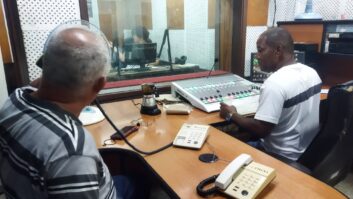
Channel and FEMA personnel monitored the test from the Clear Channel Emergency
Operations Center in Cincinnati. Jeff Bennet of Clear Channel is in foreground;
the screen shows custom software that logs EAS
activity at the company’s stations.
|
|
Some observers deemed
the test a failure because the alert was not delivered consistently and audio
quality was impaired. Others say discovering such problems was an important
goal, and that the test showed a message can in fact be delivered across most
of the country from FEMA headquarters.
Connectivity
Regulators told some members of Congress that three of 63 Primary Entry
Point stations did not receive the alert.
The Primary Entry Point Advisory Committee, a group that advises FEMA
and is made up of representatives from the PEP stations, already had been
working with the agency to improve the analog relay, or linking bridge, network
that connects FEMA with the PEP stations.
“An IP satellite system is already in place at a handful of PEP stations
but will not be turned on until the final PEP station is online,” said Mark
Manuelian, PEPAC chair and engineering manager for CBS Radio’s WBZ(AM) in Boston.
“We expect to have satellite connectivity complete before the next national test.”
PEPAC members have learned that preliminary reports from FEMA show that
about 85 percent of radio stations in the country forwarded the Emergency
Action Notification message successfully, Manuelian said.
The PEP station network is in the midst of an expansion that will
eventually bring the number of PEP stations to 74, covering about 90 percent of
the U.S. population, as Radio World has reported.
“FEMA has recognized that there are pieces that need work,” Manuelian
said. “I think we need to look next at equipment and installation on the
broadcast side. Most stations had working equipment but not all. Monitoring
assignments need to be
addressed. If stations need help they should contact their State Emergency
Communications Committee.”
Satellite delivery?
Engineers
also reported receiving double audio and poor quality audio from high up in the
relay chain. FEMA/IPAWS Program Director Manny Centeno told Radio World the
originating message was clear for the first four seconds, but that a technical
malfunction at the national primary level introduced dual header tones and
subsequently decreased the original audio quality of the message for downstream
stations. This resulted in distorted audio, according to Centeno.
|
|
Waveform is a representative sample from the
test, displaying what most people heard, according to FEMA.
|
|
EAS
equipment manufacturer Digital Alert Systems examined audio captures from the
national test and concluded that a problem in a connection between the FEMA
Operations Center and PEP station WCCO(AM) in Minneapolis caused the “mystery
header” that resulted in looped audio.
“We were
able to fully decode one of the feedback headers that erroneously appeared in
the audio. The string identifies the PEP station (WCCO) that was the source of
the audio,” stated Edward Czarnecki, senior director of strategy, development, &
regulatory affairs for Digital Alert Systems.
Neither
FEMA nor CBS, the station’s owner, confirmed this detail.
The contamination of the originating alert
message delivered via the PEP network is likely to be a focus of attention before
a second test.
Maine Association of Broadcasters President Suzanne Goucher said, “In my
view, satellite delivery [to PEP stations] should be the primary federal
delivery mechanism, with the analog infrastructure of the current system left
to be the last-man-standing backup. The system can no longer rely on 1950s
technology.”
In Michigan an estimated 10 percent of radio and TV stations had no audio
of the test or reported programming problems in their decoders, said Larry
Estlack, the state’s EAS committee chairman.
“The relay
was obviously the most serious flaw we encountered. I would hope FEMA will examine
the PEP transport system, identify its flaws and promptly make needed
corrections and improvements,” Estlack said.
Centeno said during a webinar after the
test that the time stamp on the originating message was set for three minutes
after the hour. While the message did go out at 2 p.m. Eastern, some EAS
encoders/decoders relayed the EAN immediately while others held it for a few
minutes.
Estlack said, “Some of the new boxes are quite literal, meaning if
the internal clock is a few minutes off, it will delay a message, which is what
happened in quite a few instances.
“We now have such a wide array of new and old EAS receivers out there
that there will be issues on how they handle the EAN.”
During the webinar in late November, several EAS participants debated
whether the FCC should regulate how encoders/decoders handle time-stamp and
double message header issues. Others believe the industry should develop a
solution such as best-practices guidance for manufacturers to standardize how
units function.
A baseline
All of the corporate-level broadcast engineers contacted by Radio World
shared stories of poor audio and minor glitches but agreed that the test served
its primary purpose of strengthening the system for the future.
Dave Redmund, vice president of engineering for Townsquare Media, said,
“From the observations I have received from across the country, it appears FEMA
needs to get its act together before we try [a test] again.”
At Clear Channel Radio, “A vast majority of stations successfully
received and retransmitted the EAN alert and the test served the purpose for
which it was intended, to identify and remedy any issues to improve the
system,” said Jeff Littlejohn, executive vice president of engineering and
systems integration.
Clear Channel and FEMA personnel monitored the EAN test from the Clear
Channel Emergency Operations Center in Cincinnati, according to Littlejohn.
“It was not quite what we had hoped for,” said Milford Smith, vice
president of radio engineering for Greater Media, “but it certainly can serve
as a baseline and diagnostic tool to begin and improvement effort for the EAS.
This test certainly exposed some significant concerns when expanded to the
national level.”
Centeno of FEMA echoed the baseline argument. After the
test, he posted a message on the SBE EAS Listserv, emphasizing that he was
commenting as an individual and an engineer in this instance. He said that
through controlled testing, his team plans to build a list of issues to fix and
share it with industry. “We’ve established a baseline. We’re going to re-test,”
he stated.
Immediately after the test, concerns flared about how various EAS devices
handled the EAN, though they seemed to lessen once federal officials said the
looped audio and time stamp issues had been triggered near the top of the
broadcast chain, several observers said.
Harold Price, president of EAS manufacturer Sage Alerting Systems, said,
“For the most part, EAS equipment at broadcast stations functioned properly.
The alert was damaged when it arrived at the broadcasters. It had multiple
headers.” FCC Part 11 rules don’t spell out what to do in that case, according
to Price. “Each manufacturer made its own decisions at the time the equipment
was produced, causing various results.”
Price wants the FCC to initiate a development effort with EAS equipment
manufacturers and other stakeholders to recommend technical solutions to handle
such scenarios.
Czarnecki of Digital Alert Systems said the company’s DASDEC units performed
“very well overall in the field despite the problems encountered with the
source audio.”
Decent audio
|
What
Some Stations Told the FCC
|
|
Here are excerpts from a few
of the Form 3 reports sent to the FCC identifying audio problems with the EAN
message. Call signs, licensees and manufacturer information have been omitted
at the request of the broadcasters.
“EAN was received …
Operator heard first 7–10 seconds of audio ending with ‘United States ...’ then
silence. Activation tones were audible behind the audio. Audio received and
recorded truncated to 13 seconds: The two-tone alert signal for 8 seconds
followed by ‘This is a test of the emergency alert system this is only a ...’
(silence) was recorded and forwarded by the [EAS encoder/decoder].” Message
forward start then ensued.
“EAN
was received … The entire message passed through the [EAS encoder/decoder]. The
audio had cascading activation tones and audio. The recording shows 8 seconds
of two-tone attention signal, then message text. At :13 into the audio
activation tones are heard behind the message, followed by the two-tone
attention signal and the text again. At :31 seconds the activation tones are
heard again further beneath the message.” Message forward start ensued.
“Two
problems: First, the message encoding called for a ‘valid time’ beginning at
2:03 p.m. ET. The ... EAS box considered this to be a ‘future alert’ and would
not send it until the time-of-day actually reached 2:03 p.m. Second, the
crosstalk in the audio message included low-level SAME tones, and when the
playback of the message reached the point where the SAME tones started, the
[encoder/decoder] considered that to be the end of the message, truncated the
rest of the audio and sent its own [End of Message] tones.”
“We
forwarded the audio we received, but it had substantial crosstalk and noise, as
if the original audio message was delayed and repeated at a lower level. SAME
encoding and another Attention Signal were audible under the audio message.”
|
|
Engineering forums captured the flavor of how broadcast engineers felt
following the November test and anecdotal evidence of what went wrong in some instances.
“We know now that EAS can be used to issue a national warning, we just
need to solve the problems with the audio at the source. All FEMA needs is a
good audio or broadcast engineer,” wrote Adrienne Abbott, adding that
broadcasters face these kinds of issues daily.
The Nevada SECC chair stated: “We also have to make sure the public and
our media know and understand what happened.”
Broadcast engineering consultant Bob Gonsett, publisher of the CGC
Communicator, commented in his newsletter, “The first-ever national EAS test
was a serious disappointment. One big problem: The federal government needs to
deliver decent audio to the LP1s.” Local Primary stations monitor PEP stations for
presidential alerts.
Some commenters on the SBE EAS listserv were more philosophical.
“We need to take into consideration that the people at FEMA are not
broadcasters,” stated Jerry Mathis, who handles engineering for Clear
Channel/Urban Radio Broadcasting in Tupelo, Miss. “They are not up on all the
tricks of the trade we deal with all the time, like computer time
synchronization. They are trained more to deal with disasters and government
red tape than with IP systems and certainly audio feeds. This was a successful
test of the system, the audio problems notwithstanding.”
Gary Timm, chair of the Wisconsin SECC, wrote on the AWARE alert blog, “While
some PEP stations reported the test sounded fine, other PEP stations sent the
EAS header code but had no audio of the test in states such as Minnesota and
Indiana, and another PEP station in Utah never received the test.”
Others said audio and video alerts did not appear in parts of New Mexico
and Oregon. Meanwhile, television and cable reportedly also had their own
unique challenges.
Next
Immediately after the test, the FCC and FEMA stated: “The nationwide EAS test served the purpose
for which it was intended — to identify gaps and generate a comprehensive set
of data to help strengthen our ability to communicate during real emergencies.
“Based on preliminary data, media
outlets in large portions of the country successfully received the test
message, but it wasn’t received by some viewers or listeners. We are currently
in the process of collecting and analyzing data, and will reach a conclusion
when that process is complete.”
But the need for another national test is clear, observers say. As of
late November, a date for another test had not been set. Manuelian, the PEPAC
chair, doubted a test would take place before 2013, given that the coming year
includes a presidential election cycle.
“This test made a lot of people in high places very, very nervous about
the outcome. No one will want to run the risk of another one in 2012,” said
Manuelian, emphasizing that he was expressing his personal opinion and not necessarily
those of PEPAC or CBS Radio.
Many of the possible “fixes” for EAS require funding and/or more formal
and frequent coordination of the public/private partnership of EAS
participants.Maine Sen. Susan
Collins, ranking Republican on the Senate Homeland Security and Governmental
Affairs Committee, announced plans to introduce a bill to establish an IPAWS
advisory committee composed of federal, state and local representatives as well
as industry groups. The measure would also ensure FEMA uses new
technology such as Twitter, Facebook and other social media platforms to
deliver emergency alerts on smartphones and other devices (RW, Dec. 1).
|